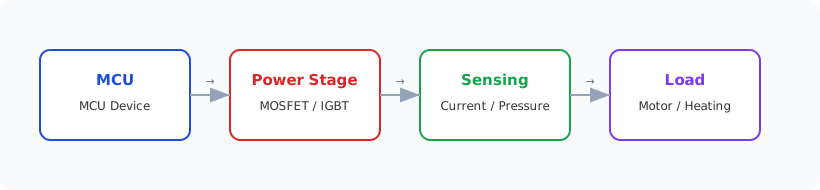
Overview
Induction heating is a resonant power-conversion application that turns electrical energy into heat in a workpiece through a high-frequency magnetic field. It is used in induction cookers, industrial heating, annealing, brazing and melting, and it places specific demands on the power switch: high switching frequency, a resonant load, and a rugged device that survives the conditions of a clamped inductive circuit. IXYS's HiPerFAST IGBTs, HiPerFET MOSFETs and fast recovery diodes fit this class of equipment, and BeiLuo supplies them with genuine traceability and FAE support.
The Resonant Inverter
An induction heater drives a resonant tank formed by a work coil and a capacitor bank. The resonant current is nearly sinusoidal, so the switching devices can be driven close to zero-voltage or zero-current switching, which reduces switching loss and supports high frequency. A HiPerFAST IGBT such as the IXGH30N60C2 switches fast and has a square reverse-bias safe operating area, so it handles the resonant load ruggedly. Where the bus voltage is lower, an IXFN44N50 HiPerFET MOSFET switches fast with a simple voltage gate and a fast, avalanche-rated body diode. Matching the device to the tank current and the resonant frequency is the key design decision.
Switching Frequency
Induction heating runs at frequencies from tens of kilohertz to hundreds of kilohertz, because the current must penetrate only the surface layer of the workpiece and the coil magnetics shrink as frequency rises. Higher frequency requires a faster device, which is where the HiPerFAST family and the MOSFETs come in. Estimating the switching loss at the actual resonant frequency is essential, and the BeiLuo FAE team can run this comparison.
Ruggedness and Safe Operating Area
The resonant load stores energy, so a fault or a mistuned condition can stress the switch. The square RBSOA of the HiPerFAST IGBT provides margin under clamped inductive switching, and the rugged HiPerFET process tolerates avalanche events in the MOSFET. Keeping current density within the datasheet rating, protecting the gate and verifying turn-off overshoot at the device terminals are the habits that keep an induction heater reliable over a long life.
Freewheeling Path
Even in a resonant circuit, a fast recovery diode is often used for the freewheeling or clamp path. The DSEI60-06A has a very short recovery time for low loss, while the DSEP60-06A trades a little recovery time for softer behavior and lower EMI. Matching the diode to the switch preserves the efficiency and quietness of the resonant stage.
Layout and Thermal Design
High-frequency resonant converters are electrically noisy, so keep the power loop tight and the connections short. Tune the gate resistor to control the edges within the EMI budget, and measure overshoot at the device terminals. For thermal design, start from the datasheet junction-to-case resistance, add the interface and heatsink resistance, and verify junction temperature at the duty cycle of the heating cycle, which is often high. The isolated TO-247AD and SOT-227B packages let devices share a heatsink easily.
Documentation and Supply
Every IXYS device BeiLuo ships is factory-traceable and includes an import declaration, a certificate of origin and a RoHS compliance file. Mainstream devices are held in regional stock, and our FAE team supports device selection, gate drive, layout and thermal sign-off, so an induction-heating design reaches production with measured confidence.
Conclusion
Induction heating rewards fast, rugged switching and a clean layout. IXYS HiPerFAST IGBTs, HiPerFET MOSFETs and fast recovery diodes deliver the electrical and thermal performance this application needs, and BeiLuo's authorized stock, documentation and engineering support make them practical to design in and keep supplied.